Pelham II: The Dialogue is Required. The Audio Decides.

The judgment in Case C-590/23 (Pelham II), delivered by the Grand Chamber on April 14, 2026, provides the definitive interpretation of the pastiche exception under Article 5(3)(k) of Directive 2001/29/EC. Nearly three decades of litigation on a two-second rhythmic loop have finally reached their end, marking a decisive (perhaps divisive) shift toward the prioritization of artistic expression under the pastiche exception.
The Court clearly intends for pastiche to be a trans-sectoral concept, applying it beyond the musical domain to all forms of artistic re-use. However, this broad, one-size-fits-all approach is precisely what makes the Court's legal standard difficult to apply in a musical context, in my view. As I see it, the Court’s framework leaves a vacuum which may result in national courts being forced to rely on the subjective claims of the sampler rather than the objective technical evidence of the audio file, effectively legalizing purely functional looping under the pretence of a creative dialogue.
1. The Court's Duality Standard: Artistic or Creative Dialogue Without Emergence
The Court confirmed that musical sampling—the electronic copying of a fragment of a phonogram to create a new work—falls under the freedom of the arts (Article 13 of the Charter). Sampling can legally qualify as a pastiche if it is used to create a work that meets the "creative dialogue" criteria set out by the Court. This interpretation serves to balance the phonogram producer's right to protect their investment (Article 17(2) of the Charter) with the user's freedom of expression and artistic freedom (Articles 11 and 13).
The Court established that pastiche is an autonomous concept of EU law. It is not a broad loophole for the lazy, but a protected space for the intentional. Or in more legal terms: It is not a catch-all (Auffangtatbestand) for any artistic use of existing material. A valid pastiche under the CJEU framework requires the fulfilment of three functional pillars:
· Evocation with noticeable difference: The new creation must evoke an existing work while maintaining noticeable differences from it.
· Overt use: The use must be open and recognizable as such. The Court explicitly excludes plagiarism or hidden imitations from the scope of the exception.
· The artistic or creative dialogue: engagement in an "artistic or creative dialogue" with the original work is required. The Court establishes that a dialogue can only be established if the elements used in the new creation are characteristic of the work or works from which they are derived (51). This includes that, to a certain extent, a pastiche must allow for the use of protected elements (52).
This dialogue can take various forms, including:
· Humorous or critical engagement
· Tribute/homage
· Overt stylistic imitation
The Court decoupled pastiche from the requirement of humour or mockery, confirming it is a neutral tool for transformative work.
The Court also acknowledges that a phonogram producer may, by virtue of the right conferred on him by Article 2(c) of Directive 2001/29 to authorise or prohibit the reproduction of his phonogram, in principle, object to the use by a third party of an audio excerpt from his phonogram for the purpose of incorporating that excerpt into another phonogram in such a way that it remains recognisable to the ear. Consideration 56 re-affirms the phonogram producer's right to object to any sample that remains recognisable to the ear. Consideration 57 then provides the safe harbour: that right is balanced where the pastiche exception applies - but only if the requirements of paragraphs 49 to 53 are met. Under the Court's ruling, a recognizable sample may activate the pastiche defence - provided it constitutes a creative dialogue with the original.
So, what constitutes that creative dialogue? In consideration 28, we can read what OLG Hamburg's approach to a creative dialogue was.
The Oberlandgericht Hamburg found that the song ‘Nur mir’ evokes the rhythm sequence taken from the song ‘Metall auf Metall’, while being noticeably different from it, but is neither a stylistic imitation of that rhythm sequence nor an expression of humour or mockery. That court also found that the song ‘Nur mir’ artistically engages with that rhythm sequence, inasmuch as that sequence is reproduced in a song of a different music genre, while being, despite the reduction in tempo and the metric modulation, recognisable as alluding to the original. (28)
The above reasoning is problematic to me, as it seemingly assumes merely using a sample and placing it in a new track creates a creative dialogue. In other words, 1 + 1 = 2; work A exists in work B and therefore creates a new meaning that didn’t exist in both works separately. Suppose the sample is not a drum pattern, but a musical phrase or motif. The instrumentation and arrangement will need to fit the musical content of the original work. Is that sufficient creative dialogue? The Court does not say. But to me, accommodation is not transformation. If a producer merely accommodates a sample—making the track's tempo and key match the loop so it fits—they haven't engaged in a dialogue; they've performed a mechanical installation. If the OLG Hamburg's reasoning is the floor, and national courts follow it, duality becomes sufficient for creative dialogue - and the pastiche exception becomes precisely the catch-all the CJEU claims to reject.
Accepting duality as sufficient for a creative dialogue would mean that the bar for the pastiche exception is lower than the low B on a 5-string bass, thereby failing musicians and phonogram producers by hollowing out their rights and creating a legal shield for extraction of performers' intellectual creation. Without additional case law to constrain the boundaries of creative dialogue, the pastiche exception risks becoming not a defence but a default - and the result, for rights holders, will be cacophony.
2. No Subjective Intent Required
Perhaps the most significant shift for IP practitioners is the Court's rejection of subjective intent. We are moving away from what the creator meant in the studio and toward an 'informed listener' standard. The Court rules that "it is sufficient that the ‘pastiche’ nature be recognisable for a person who is familiar with the existing work from which the elements have been borrowed." (61-62). Notably, the Court dropped the BGH's 'requisite intellectual understanding' qualifier from its operative answer - leaving a standard defined by nothing more than familiarity with the source work. Without the 'requisite intellectual understanding' qualifier, perception becomes recognition - and recognition is not analysis. That makes the Court's assessor a fictional character*. But if they cannot recognize the source work, the analysis ends. No pastiche. That such standards function in other IP domains does not resolve the problem here: music production requires technical criteria beyond pattern recognition that the 'familiar listener' simply cannot supply.
3. The Non-Duality Standard
The familiar listener clears the threshold. National courts then do the substantive work: assess the artistic or creative dialogue. And the Court has no technical standard for that substantive assessment.
The CJEU’s decision doesn’t provide a definitive practical answer whether a sample can be considered a pastiche. It comes up with the vague standard of creative dialogue. On one hand, the Court makes clear that: "the concept of 'pastiche' cannot be interpreted as covering every creation that evokes an existing work and is noticeably different from it" (43). On the other hand, the Court’s consideration that in order for such a dialogue to be engaged in, it is necessary that the elements used in the new creation be characteristic of the work or works from which they originate (51), is quite puzzling. Consideration 51 seems to create a structural paradox: by requiring characteristic elements as the threshold, the Court makes the pastiche exception easiest to invoke precisely where copyright protection is strongest.
So, I have questions:
· Does it suffice merely to use a sample in a new creation: lift a few bars of the original work and paste in the new track?
· How much creativity is required?
· Is non-duality required? In musicology, pastiche demands emergent synthesis**
The Court describes what the dialogue looks like in form, but it does not say how to measure whether the artistic or creative dialogue is genuine. If the dialogue must be recognizable as dialogue (50), you need a measurable standard to determine that. Let’s see, in practice, how the standard of a 'creative dialogue' could be translated into a practical assessment, and refined to work in musical context, but at the same time, preserving the trans-sectoral integrity the Court wants.
While not legally binding under the Court's autonomous definition framework, the musicological tradition of pastiche offers technical criteria that national courts currently lack. The Oxford Companion to Music defines a pastiche as an imitation, a work written partly in the style of another period, where the creator has imitated the style of another writer or artist. In musicological context, a pastiche is historically a composition technique, it is a deliberate stylistic device, used to look back to the style of a different era (nostalgic/historical). Not a literal copy, but recognizably altered. We live in an age of pastiche pop, think of Daft Punk’s Get Lucky, which is basically pastiche music: an homage to 70s funk aesthetics without direct sampling. In soundtracks, pastiche is also an often-used technique. Think of Hans Zimmer vs Ennio Morricone (check the playlist). Translating the compositional tool of a pastiche to the neighbouring rights domain is a bit more complicated.
As I see it, the Court's consideration 51 seems to suggest that non-duality must exist in the new work, whether that was intentionally implied or not. Non-duality means that the identity of the sampler subsumes the identity of the original work sampled from. The requirement of 'evocation with noticeable difference' does not imply duality necessarily, and thus leaves room for non-duality as the operative standard the Court's creative dialogue already demands but does not yet articulate.
The non-duality requirement actually could be useful as a fence around the objectified creative dialogue. Unlike 'creative dialogue,' non-duality is falsifiable: the audio file either contains measurable forensic displacement or it does not. Without 'Non-Duality' (1 + 1 = 3), the pastiche exception isn't a legal defence—it's an extraction permit. While this is my own interpretation, I believe it could provide a further refinement that the 'Objectified Creative Dialogue' - standard as formulated by the Court currently lacks. It would serve as a fence that aligns the pastiche test better with the three-step test, being—and I paraphrase—an exception (like pastiche) is only valid:
1. It is a specific, limited case.
2. It does not conflict with the normal exploitation of the work.
3. It does not unreasonably prejudice the legitimate interests of the rightholder.
The origins of the pastiche composition technique offer some guidance. Pastiche breathes new life into old styles, detached from their original context. It requires temporal separation - the distance between the original style and the present day is not incidental but constitutive of the meaning. The piece comments on history precisely because it is not of it. In that transaction, the borrower's identity subsumes what has been borrowed. What remains is not a dialogue between two voices, but a single new voice that carries the memory of the original. Three examples illustrate where that line could fall - and where it could not.
4. Practical Scenarios: Sampling as Dialogue
A. The "Subversive Dialogue" (Critical engagement)
Example: Massive Attack – Safe from Harm
The sample: Billy Cobham - Stratus
· The Workflow: The specific rhythmic and harmonic engine consisting of Leland Sklar’s signature bass performance, Cobham’s drums, Jan Hammer's mini-moog synth solo and a Tommy Bolin guitar fragment. The elements were sampled (tempo slowed down/looped) through an Ensoniq EPS keyboard sampler. This created a heavy, subterranean timbre that shifted the original's kinetic energy into a slow, menacing pulse.
· Overt use: Yes
· The creative dialogue: It uses the "characteristic elements" of the source to create a "critical engagement." The dialogue lies in the tension between the original’s innocence and the new work’s grit. You hear Stratus immediately. It creates an entirely different emotional universe: jazz/rock fusion vs. Urban Bristol trip hop of the 90s. SFH is in the same key as Stratus. Shara Nelson’s and Robert Del Naja's vocals are contradictory to Leland Sklar’s bassline which continues to plough through the entire track. Del Naja follows Sklar's 16th notes ostinato, while Nelson's detached legato, and slightly behind-the-beat vocals contrast the bassline. Nelson's vocals avoid the triads but stay in sus-territory with 7th/9th. The synth/guitar sample from Stratus is used as rhythmic punctuation in the bridge between Nelson's and Del Naja's vocals. Cobham’s chordal essence Bm/E is submerged in SFH to a Bm variations (sus2 and sus4 chords) loop. Massive Attack took the dominant, driving force of the original and made it a suspended, unresolved internal note within a Bm-family chord.
· The noticeable difference: Extreme manipulation of Timbre and Genre-Framing. The technical exuberance of 70s fusion is extinguished and replaced by 90s Bristolian gloom. The original "soul" of the track is overwritten by Massive Attack's dark, protective narrative.
· Non-duality through engagement: the identity of Massive Attack occupies the characteristic elements of the source, rendering the original intent a recognizable but powerless ghost. SFH is a literal sample from Stratus and on the surface it sounds like a utility lift. This example, however, proves the non-duality rule. The parts of Stratus have been transmuted in SFH; the dialogue lives in the friction between the original and new track. The original identity is displaced and then subsumed by the new one, thereby reaching emergent synthesis.
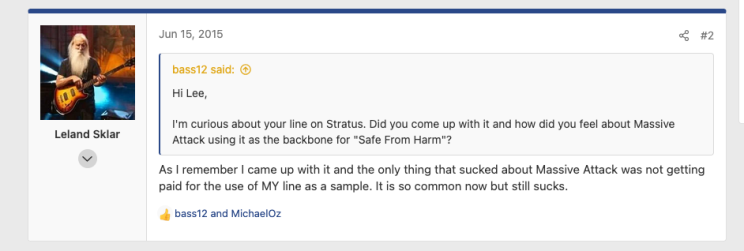
Del Naja's comment seems to qualify his sampling as a low-effort accident. In a world of "subjective intent," his quote would be a confession that kills the pastiche defence. Under the Court's objectified creative dialogue standard, however, this is irrelevant. What matters is the result and what the informed observer hears in the audio. The evidence is in the audio. In SFH there is transmutation. The original identity has been displaced by a new third entity (1 + 1 = 3).
In the last decade, computer power has changed everything. In the mid-80s, we were using samplers to steal things in a completely anarchic and selfish way. We stole whatever we felt we wanted. You worked within your parameters, sampled a few seconds and then you’d be able to make a track out of it. Take a few bars from Billy Cobham’s Stratus…And boom, Safe From Harm was made. We’ve made a lot of lawyers very happy over the years by sampling, so we were like – OK, maybe it’s time to sample our own music. ~ Robert Del Naja (Massive Attack)***
B. The "Era-Anchor" (Tribute/Homage):
Example: The Weeknd – "Secrets"
The Sample: Tears for Fears – Pale Shelter (You Don't Give Me Love)
· The Workflow: sampling (time stretched/compressed/sidechained/EQ’d/filtered) a specific 80s analogue synth/guitar sequence to ground a modern track in that specific historical aesthetic. The sidechaining forces the 80s synth architecture to 'duck' in sync with a modern, high-excursion kick drum—physically subordinating the original's frequency to the new track's rhythmic grid.
· Overt use: Yes
· The artistic dialogue: Pale Shelter is a polished synth-pop track built from lush Roland synth (a.o. Jupiter 8) layers, tight drum-machine rhythms, and a memorable acoustic guitar riff that heightens Curt Smith's emotional vocal performance. The production was innovative in the early 80s. The sample of the arpeggiated synth and acoustic guitar acts as a "tribute" to a specific sonic era, over Tesfaye's R&B vocals. Both the arpeggiated synth and acoustic guitar samples are stripped of their warmth and higher frequencies through filtering to create space for Tesfaye's vocal timbre and moody R&B/electronic production. The acoustic guitar's natural breath and attack are suppressed on every beat, the synth arpeggio ducks in sync with contemporary low-end. Both 'Secrets' and 'Pale Shelter' are in the key of A minor, with the same harmonic scaffold in the verse. But the shared E becomes a timbral ghost in Secrets. The harmonic identity of Tears for Fears has been reduced from a richly extended, emotionally unified two-chord world to a textural residue inside a far simpler framework in Secrets. The engagement here is primarily artistic rather than creative in the compositional sense - which is precisely what the tribute form demands.
· The noticeable difference: Integrating the vintage samples with modern low-end R&B/electronic production that didn't exist in the original era. The Pale Shelter sample has become a stuttering synth pulse in Secrets. The modern low-end architecture, the G Mixolydian harmonic shift, and the contemporary vocal processing reframe both vintage elements entirely.
· Non-duality through assimilation: The Weeknd so thoroughly occupies the Pale Shelter aesthetic that the original is no longer Tears for Fears—it has become The Weeknd's Retro-Future. The arpeggiated synth is everywhere, but Tears for Fears is nowhere. The guitar washes surface in the bridge as a narrative pivot, exposed briefly before The Weeknd's production returns to subsume them.
C. The "Sonic Blueprint" (Overt stylistic imitation)
Example: Daft Punk – Digital Love
The Sample: George Duke – I Love You More
· The Workflow: Daft Punk sampled the original George Duke intro, then used a hardware sequencer to micro-edit the loop. They took Duke's fluid, loose jazz-funk timing and "snapped" it to a rigid, 4/4 electronic house grid. They also applied a Phaser/Filter sweep that evolves over time—a classic "French House" processing technique.
· Overt use: Yes
· The artistic or creative dialogue: A dialogue with the History of Disco and Funk. They are imitating the style of 1970s funk while simultaneously re-tooling it for the 21st-century dance floor. The dialogue is: "I am taking your analogue warmth and giving it digital precision." Duke's analogue warmth disappeared in the transformation. It found a new architecture to inhabit. That is the difference between extraction and dialogue. In this example, the artistic and creative dialogue are both present.
· The noticeable difference: new melody, new arrangement, and updated production "shimmer", which transforms Duke's disco vibe to French house.
· Non-duality through transformation: The George Duke loop is the architectural backbone of Digital Love - remove it and the track collapses. But Duke's jazz-funk timing has been arithmetically removed: the fluid, human swing of the original has been quantized to a rigid 4/4 house grid, its BPM stretched from 108 to 123, its static analogue timbre replaced by an evolving phaser sweep. What remains of Duke is a rhythmically precise, timbrally mechanized skeleton. Daft Punk's vocoded vocals, guitar solo, and synthesizer architecture then occupy that skeleton completely. The informed observer does not hear George Duke. They hear Daft Punk's version of what 1970s funk sounds like rebuilt from the inside out. Duke's DNA is the sonic blueprint. The building is entirely Daft Punk's.
The above examples show that in practice, it will be challenging to make the factual assessment of the pastiche test. What is the difference between an objectified creative dialogue versus a direct lift? The audio evidence in these examples proves that the sampler did not merely mechanically install the source; they used songwriting and production techniques to overwrite the original identity. These are not subjective artistic choices—they are measurable forensic displacements. The above examples constitute, in my view, an objectified creative dialogue between the sample and the new work. In other words, 1 + 1 = 3 in the above examples. The Court’s considerations 49-53 seem to lean more towards layering (see above 1 + 1 = 2). The Court’s current framework risks being interpreted as a simple additive process: 1 + 1 = 2. However, in my view, a pastiche must achieve a state of non-duality where the result is emergent: 1 + 1 = 3. If removing the 'summoned' sample does not collapse the identity of the new work, then no dialogue has occurred—only a utility lift. To qualify for the pastiche exception, the borrower must not just add the source; they must synthesize it into a sovereign third entity. If there is just addition, there is no dialogue and what remains is extraction.
The question I have in this context is how the courts will deal with a sample that is looped throughout a track and forms the backbone of that track, such as a drumbeat, a bass line, a keyboard groove, string or horn motif that is highly recognisable. The answer may lie in whether the loop is the architecture or merely the furniture. In Massive Attack's SFH, the drum/bass loop is the architecture; in 'Nur mir' the drum loop is the furniture: the new work doesn't 'answer' Kraftwerk, it just sits on top of it.
This means that the analysis of the pastiche test will have to be done by the national courts. Characteristic elements are the threshold. Non-duality is the standard. The Court has identified the former without requiring the latter. The burden of proof, in practice, will be significant. In the absence of expert musicological analysis, a forensic assessment of such evidence - and thus the application of the pastiche exception itself - will be impossible.
Listen to the examples on Tidal & Spotify
5. The "Red Line": Lazy Looping
The Court was explicit: Efficiency is not a dialogue. If a sample is used as a "brick" to fill a rhythmic gap, provide a "sound," or save time, it remains a prima facie infringement under Article 2(c). The exception protects the transformative signal, not the administrative noise of production.
Sabrina Setlur’s producer Moses Pelham sampled a 2-sec loop from Kraftwerk’s Metall auf Metall (MAM) track. This is an interesting one because 'Nur mir' literally copies the entire drum pattern of MAM: kick, snare, percussive sounds. Kraftwerk’s identity is present in Setlur’s track, but next to Setlur’s own musical identity. Pelham used the sample as a drum machine. So, would 'Nur mir' pass the pastiche exception requirement set out by the Court?
· The workflow: Pelham sampled a 2-second drum pattern from MAM
· Overt use: Yes
· The artistic or creative dialogue: the MAM-sample functions as a mechanical substitute. The sample does not "answer" the vocals, and the vocals do not "re-contextualize" the sample.
· The noticeable difference: Pelham took a 2-second loop, slowed it down by a negligible margin, and looped it. The "difference" is not "noticeable" in a transformative sense; it is a structural copy.
· Non-duality: In 'Nur mir', the identities remain dual. You hear a Kraftwerk loop + a Sabrina Setlur vocal. They sit on top of each other like layers in a file, but they never fuse into a new, non-dual sovereign identity. The "soul" of Kraftwerk is being used as a battery to power a different machine, but the essence itself remains unchanged and unengaged.
In my view, if 'Nur mir' is granted the pastiche exception, then lazy looping is legalized (remember Vanilla Ice?). It would mean that any artist can take a "characteristic element" for pure utility and simply label it "dialogue" after the fact.
Conclusion
While the Court correctly attempts to distinguish between a creative dialogue and a utility lift, its framework remains musically opaque and insufficiently clear. Without further refinement from national case law, the post-Pelham II landscape risks turning the exception into a free ticket to commercial fame—wiping out the clearance economy and the rightsholders' right to decide who may speak with their voice. This lack of technical resolution has unintended consequences. By failing to provide a high-resolution technical standard, the Court seems to pave the way for extraction of a track's essence through the lens of artistic conversation.
While the Court identifies the basic condition of the pastiche exception that a creative dialogue is required, I contend that such a dialogue necessitates a state of non-duality; without the manifest evidence of this emergent synthesis, the use remains a purely functional extraction. The Court has opened a door it has not yet framed. How national courts choose to walk through it will determine whether the pastiche exception remains a creative dialogue without a measurable threshold, or whether we can finally achieve a perfect sync—a resonance between two voices that the law has yet to fully understand.
________
References & further reading:
* https://ipkitten.blogspot.com/2026/04/cjeu-delivers-pastiche-style-judgment.html
** Rodney Stenning Edgecombe, 'The Varieties of Musical Pastiche: A Taxonomy', The Musical Times, Vol. 158, No. 1938 (Spring 2017), pp. 27-43: Edgecombe speaks of tertium quid, the original model must be displaced from its own era and context and forced into the pasticheur’s own specific artistic language.
*** https://recordcollectormag.com/articles/brothers-in-rhythm
https://www.tommybolinofficial.com/interview-lee-sklar
Link to Nur mir: https://www.youtube.com/watch?v=9RUbxEO-A-w&list=RD9RUbxEO-A-w&start_radio=1